Tombs of the Ancient Kings
The Horse and His BoyTombs of the Ancient Kings stand where the grass ends and the desert begins beyond Tashbaan. Their great, dark, beehive-shaped stones make them unmistakable from the city’s outskirts, but their reputation for being haunted keeps Calormenes away. The fugitives choose them as a meeting place; when Shasta arrives alone at dusk, the tombs turn a rendezvous into a test of fear and trust.
Setting and Appearance
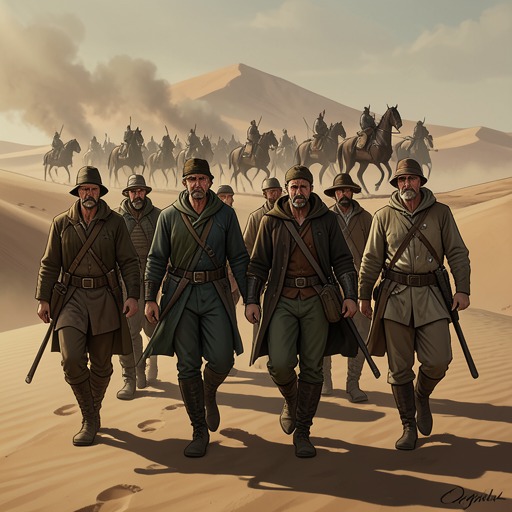
The tombs lie at the desert’s edge, a short walk from the road Shasta takes out of Tashbaan. From the far end of the bridge, he leaves the dispersing crowd and walks between gardens toward a slope. There the grass stops abruptly and level sand stretches ahead, with the mountains looming beyond it. About five minutes’ walk to his left, the tombs rise in great masses of mouldering stone, narrower than gigantic beehives and black against the setting sun.
Their shape makes them easy to find, just as Bree predicts, while their bleak appearance gives the place a markedly different character from the crowded, hot city. They are a literal threshold: behind Shasta lie Tashbaan’s streets and walls; ahead is the open desert and the route toward the mountains.
Rendezvous Beyond Tashbaan
As the travelers approach the city, they agree that they need a meeting place in case they are separated while passing through it. Bree proposes the tombs because no one could miss their beehive-like forms and because Calormenes avoid the site, believing it haunted by ghouls. Aravis asks whether it really is haunted. Bree dismisses the local tales, and Shasta claims not to care about them either, though the narration makes clear that his confidence is not entirely genuine. The group settles on the tombs as its assembly point, even as Hwin points out that choosing where to meet does not solve the harder problem of getting through Tashbaan.
The rendezvous gives the travelers a concrete plan for surviving the city’s risks, but it also depends on each of them reaching the far side alone if necessary. That distinction matters when Shasta emerges from the city without knowing whether his companions have escaped. He expects them to wait on the far side of the farthest tomb, away from anyone who might see them from Tashbaan, and heads west toward the landmark while searching the glare of the sunset for signs of them.
Shasta Alone at the Tombs
Shasta finds no companions at first. As darkness gathers, the silent stone shapes unsettle him, and the ghouls he had claimed not to fear return to his thoughts. When something touches his leg, he cries for help, too frightened to run. He turns to face it and discovers that the touch came from a cat. The relief comes from looking rather than fleeing: the feared presence has a small, recognizable explanation, though the animal itself remains mysterious to him.
In the failing light, Shasta can make out little beyond the cat’s size and solemn bearing. Its eyes seem to him to hold secrets, and he wonders whether it can talk. The tombs thus serve not only as a meeting point but as the setting for a first encounter that unsettles his assumptions about what may be present in the desert. The evidence establishes that the cat touches him and eases his immediate fear; it does not identify the animal’s nature at this moment.
Reputation and Significance
The tombs’ supposed haunting is a practical advantage to the fugitives: a place shunned by local people is less likely to expose their meeting. Yet the same reputation magnifies Shasta’s vulnerability once he is there alone. Bree can treat the Calormene stories as something not to believe, and Shasta briefly imitates that assurance; in the darkness, his fear shows the gap between bravado and actual confidence.
The site also gathers the journey’s central contrast between captivity and freedom into a landscape. The fugitives are moving out of Calormen, where Bree has been enslaved and Shasta has lived under Arsheesh’s authority, toward lands beyond the desert. At the tombs, however, freedom is not yet safety: Shasta has crossed the city’s boundary but does not know whether his companions are near, and the open route ahead begins in isolation. The tombs mark a passage into the next stage of the escape while making its uncertainty tangible.